
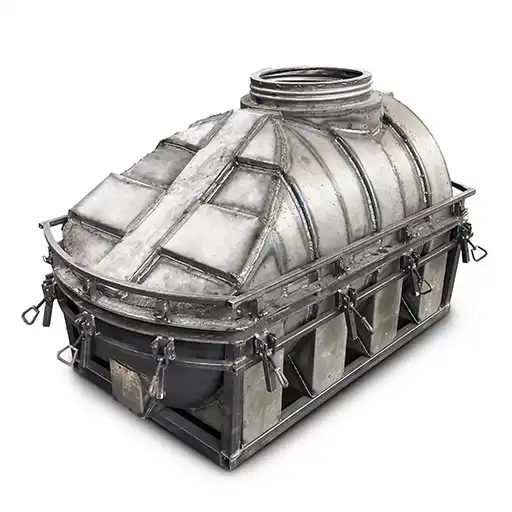
500-liter under-stairs tank
Designed and manufactured by Doran Fydar Maham Company
Under-stairs tanks, as their name suggests, are designed to fit well in the empty space under the staircases of houses, buildings and facilities. Under-stairs tanks produced by Doran Fydar Maham Company are made of polyethylene. The rotational mold for the under-stairs tank is also produced by Doran Fydar Maham and the customer can also purchase it if desired. This mold is made of ST37 iron sheet and in addition to the tank door thread insert that is available in the mold, other inserts can be installed in the rotational molds to install brass fittings or other desired fittings.
500-liter under-stairs tank
Designed and manufactured by Doran Fydar Maham Company
Under-stairs tanks, as their name suggests, are designed to fit well in the empty space under the staircases of houses, buildings and facilities. The under-stair tanks produced by Doran Fydar Maham Company are made of polyethylene. The rotational mold for the under-stair tank is also produced by Doran Fydar Maham and the customer can also purchase it if desired. This mold is made of ST37 iron sheet and in addition to the tank lid thread insert that is available in the mold, other inserts can be installed in the rotational molds to install brass fittings or other desired fittings.
• Less weight compared to steel tanks
• Possibility of storing drinking water, acid, toxins, etc.
• High tensile strength
• Usable at any temperature and weather conditions due to high expansion and contraction coefficient
• Easy repair of damaged areas
• No chemical disturbances with solutions inside the tank
• Resistant to UV rays
We at Fydar Maham, with more than 15 years of experience in the rotational molding industry, are proud to provide services such as tank analysis and optimization and mold repair and modification to customers, and we are also able to turn their ideas into reality. By benefiting from the skills and experiences of engineers and technical personnel, we can produce a product according to customer requests. After receiving the customer’s idea, our engineers model it, perform the necessary analyses and simulations to eliminate defects and errors, and modify and optimize the product design, and finally, after receiving approval, enter the molding phase and present the final product mold to the customer. The steps of turning an idea into a product are engineered in such a way that any economic loss or waste of time is prevented so that both parties suffer the least loss.