
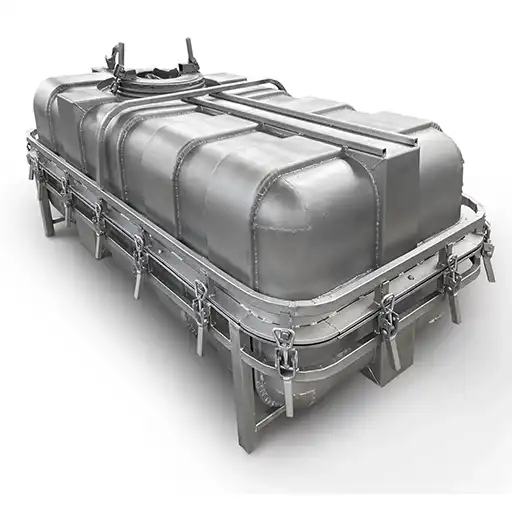
Designed and Manufactured by Davaran Fydar Maham
Application and Spatial Design Advantages
Cubic tanks are ideal for locations with limited vertical space.
This tank has a height of only 80 centimeters, making it a perfect solution for facilities, buildings, and industrial sites where vertical clearance is restricted.
Its cubic design allows for optimal use of horizontal space and makes installation and maintenance highly convenient.
Material and Benefits of Polyethylene Tanks
Tanks produced by Davaran Fydar Maham are made of polyethylene — a durable and versatile material.
Advantages of Using Polyethylene
- High resistance to brittleness — even at low temperatures and in harsh conditions
- Suitable for any climate and temperature — due to high expansion and contraction coefficient
- Safe for storing drinking water, pesticides, acids, and chemicals — no chemical interaction
- Easy repairability — damaged areas can be quickly fixed without specialized tools
- UV-resistant — no discoloration or cracking under direct sunlight
Mold Fabrication and Production Process
The rotational mold for the 1500-liter cubic tank is made from ST37 steel sheet, manufactured with high precision and in accordance with industrial standards.
Technical Features of the Mold
- Integrated metal insert for creating threaded openings on the tank lid
- Ability to embed brass fittings into the tank walls using inserts
- Optimized design to reduce waste and improve production quality
Specialized Service: From Idea to Final Product
Both the product and mold of the 1500-liter cubic tank were fully designed and manufactured from scratch by Davaran Fydar Maham.
In addition to repairing and modifying customer molds, we are ready to turn your idea into a real product.
Idea-to-Product Process
- Receiving the customer’s initial idea or sketch
- 3D modeling using specialized software
- Performance simulation in software environments (e.g., ANSYS, Abaqus)
- Analyzing and predicting defects before physical production
- Optimizing the design for simplicity, strength, and cost reduction
- Mold production and delivery to the production line or customer
This precise, engineering-driven process prevents wasted time, expenses, and defective product manufacturing.