
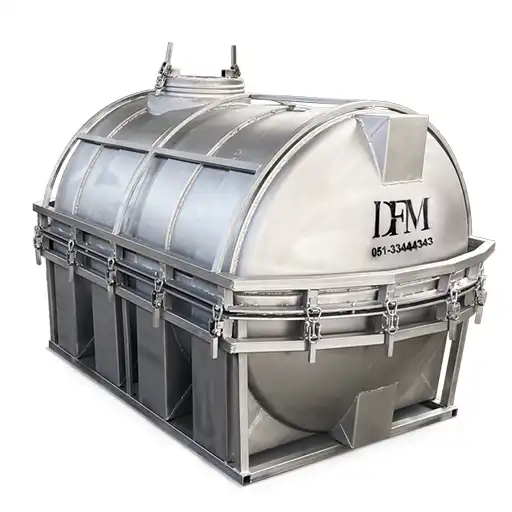
Designed and Manufactured by Davaran Fydar Maham
Application and Advantages of Horizontal Tanks
Horizontal tanks are ideal for locations with limited height clearance.
Compared to vertical tanks, they exhibit minimal and barely noticeable deformation under load. Due to their special design, they do not leak water during transportation.
Integrated Support Base Design
The support base of the tank is integrated into the product’s design.
This feature eliminates the need to purchase separate bases for installation and support, making the setup faster and more cost-effective.
Material and Build Quality
The 2000-liter horizontal tank is made of polyethylene.
This material, due to its widespread use and numerous advantages, is an ideal choice in the rotational molding industry.
Advantages of Using Polyethylene
- Low-cost raw materials due to domestic production
- Ability to store various pesticides and chemical liquids
- No chemical interaction between tank contents and its walls
- High resistance to cracking and mechanical stress
- UV-resistant (ultraviolet)
- Suitable for use in all environmental conditions, including direct sunlight, high and low temperatures, and humid environments
Mold Fabrication and Production Process
The rotational mold for the 2000-liter horizontal tank is made from ST37 steel sheet.
The mold production process is as follows:
- 3D modeling of the product
- Precision cutting of steel sheets
- Welding components to form the initial mold shape
- Machining of weld points to achieve a smooth surface
- Polishing surfaces to increase precision and quality
- Adding the support frame and clamping system
- Delivering the ready mold to the production line or customer
Advanced Mold Capabilities
The rotational molds produced by Davaran Fydar Maham offer the following capabilities:
- Embedding brass or plastic fittings into the tank wall
- Creating threaded openings on the tank lid using inserts
- Registering the customer’s brand on the final product in raised or recessed form
Specialized Service: Turning Ideas into Products
You may have an idea for a specific product but don’t know how to turn it into reality.
Davaran Fydar Maham, with over 15 years of experience in the rotational molding industry, is ready to assist you in this journey.
Steps to Turn an Idea into a Product
- Designing the initial 3D model of the customer’s idea by engineers
- Optimizing and refining the design based on production and application conditions
- Simulating product performance under real loading conditions
- Analyzing and predicting potential defects, and resolving them before production
- Receiving final approval from the customer
- Producing the mold and delivering it to the customer
This process is designed to achieve the highest quality output in the shortest time and lowest cost.