
Designed and Manufactured by Davaran Fydar Maham
Introduction to the Polyethylene Pressure Tank
The polyethylene pressure tank is available in a 150-liter capacity and is suitable for use in hydrophore systems, industrial equipment, and water supply installations.
Due to its special design and use of high-quality materials, this tank is capable of withstanding high internal pressures.
Advantages of Polyethylene Tanks
Polyethylene tanks offer numerous benefits in addition to their high strength and durability, making them an ideal choice:
- Low cost due to domestic production of polyethylene
- Suitable for use in any temperature and under direct sunlight
- No corrosion when exposed to moisture or humid environments
- Easy and convenient repair of damaged areas
- No chemical interaction between the tank material and its contents
Pressure Tank Mold Manufacturing Process
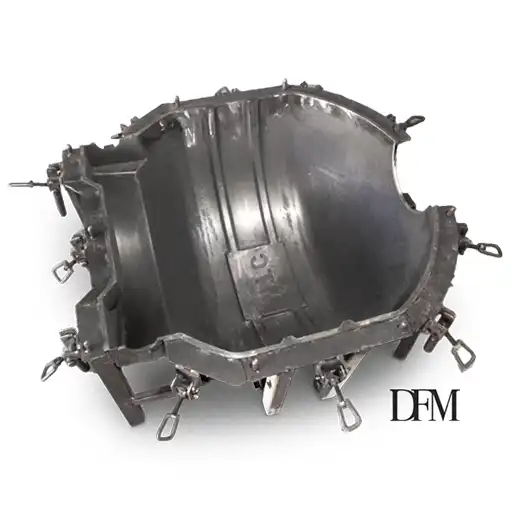
The 150-liter pressure tank mold is made from ST37 steel sheet.
The mold production process is as follows:
- 3D modeling or technical drawing of the product
- Precision cutting of steel sheets
- Bending the sheets into the desired shape
- Welding components to form the initial mold structure
- Machining surfaces for dimensional accuracy
- Polishing the inner surface of the mold to produce a tank with a smooth and uniform finish
Advanced Mold Features
The following advanced capabilities are integrated into the mold:
Branding on the Product
- The company brand is engraved recessed on the mold surface.
- Option to register the customer’s brand on the final product in raised or recessed form.
Fitting Insertion and Threading
- Embedding brass fittings into the tank walls
- Creating threaded openings on the tank lid using inserts
Specialized Service: Turning Ideas into Products
The engineers at Davaran Fydar Maham, with over 15 years of experience in mold manufacturing and rotational molding, are ready to assist you in turning your idea into a real product.
Steps in the Idea-to-Product Process
- 3D modeling of the customer’s idea
- Optimizing and refining the design based on production and application requirements
- Analyzing and simulating product performance under real loading conditions
- Predicting and resolving potential defects before production
- Receiving final approval from the customer and supervising engineer
- Mold production and preparation for mass production
This process is designed to deliver the highest quality product in the shortest time and at the lowest cost.