Warpage and how to prevent it in rotational molding ?
Rotational molding is among the easiest plastic manufacturing techniques. This does not mean the process is problem free. Considering some parameters would be quite helpful in preventing or controlling the possible issues. Parameters such as mold’s heat transfer rate, oven temperature, time spent in the oven, time spent cooling the mold, the resin’s type, and the pigment’s effect on physical properties all play a role in affecting the quality of the final outcome.
Failing any of the parameters will result in defective parts. Warpage, for example, can be one of the results of such failures.
Warpage
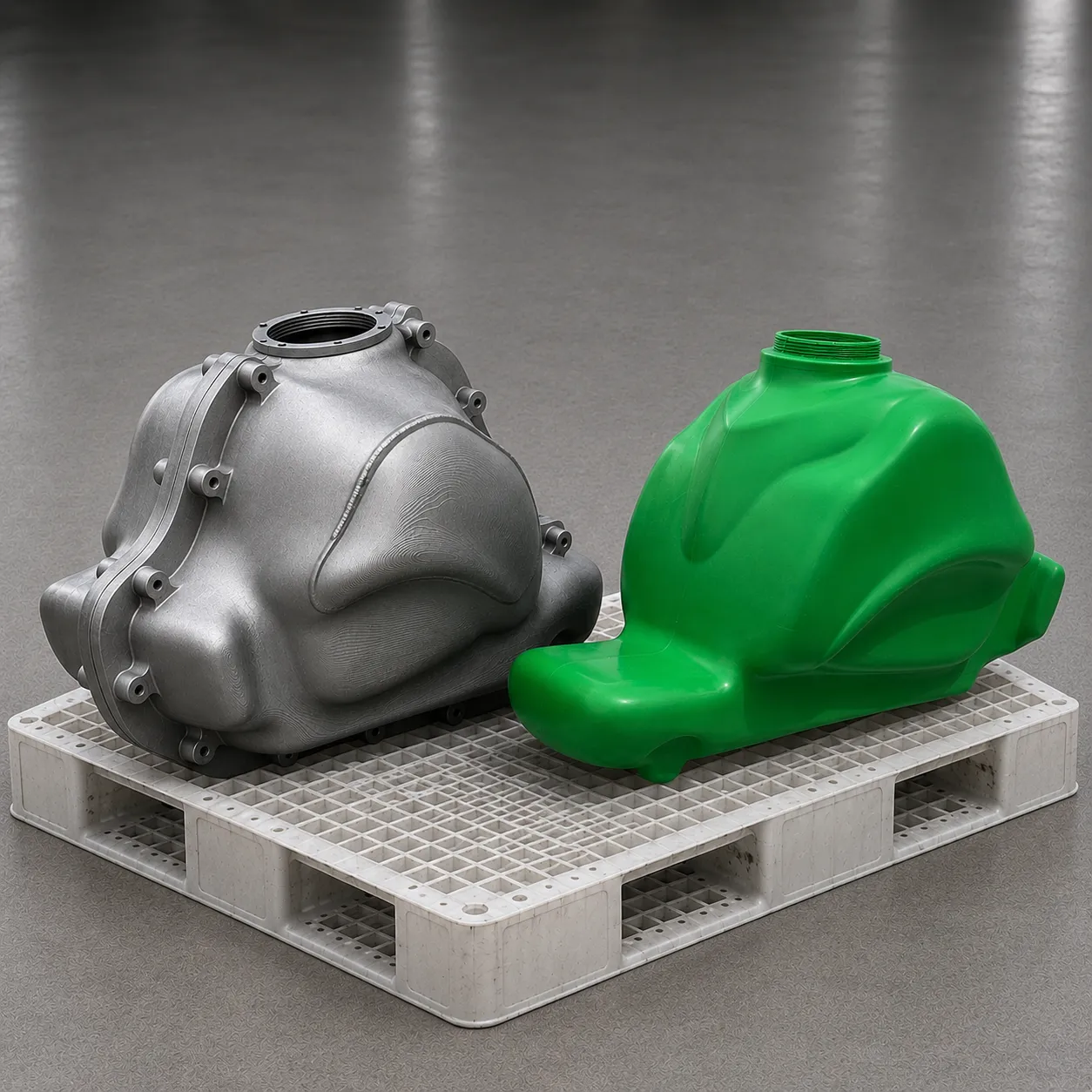
Warpage is when a part bends or changes shape. It can be mild and barely even visible and also sever to the point of making the part unusable. Many things attribute to the warpage of a part. The position of inserts and the part’s shape are an example of these.
Warpage is when a part bends or changes shape. It can be mild and barely even visible and also sever to the point of making the part unusable. Many things attribute to the warpage of a part. The position of inserts and the part’s shape are an example of these.
As the first step the designer must have in mind a degree of freedom for the movement (due to shrinkage) of the inserts position. Generally anything that constrains parts shrinkage must be removed. Preventing the plastic from shrinking will result in residual stresses. Although the latter might not be noticeable in short term, premature cracks and fractures will occur later on. An undercut is depicted in the picture below which will end up in either premature cracks or warpage of the part.
Part’s wall thickness is another factor contributing to warpage. Basically, thicker walls tend to shrink more than thinner walls due to slower cooling times in thick walls. The difference in wall thickness will cause variability in shrinkage of different areas which will eventually lead to warpage. This is particularly hard to control since the corners are usually thicker than other areas of the part. The issue can be more critical in parts with flat surfaces.
What happens is that basically the edges of the part are constrained by mold corners while the resin, mostly on centers of the flat surface, will start pulling away from the mold. The result is a bowed or warped flat surface.
Temperature can be assumed another one of the critical parameters affecting warpage. As it was said, warpage can be considered as a measure of the nonuniformity of the shrinkage of the part. In the oven, the uniform heat transfer will result in uniform wall thickness which will reduce warpage by maintaining a mostly uniform shrinkage. But how does temperature itself affect shrinkage?
It does not. It’s the temperature difference across the part’s wall that does. The uniform cooling rate can then be a rather integral factor. Fast cooling methods such as quenching the mold will cause warpage because the outer surface of the part cools down way quicker than the internal surface. If one can cool both internal areas and external areas equally then there will be no restrictions in cooling rates.
Further on, in addition to what has been said, other causes of warpage and ways to prevent them is described.
1.Improper Venting:
It’s suggested to implement a vent with 13mm inside diameter per cubic meter.
2.Non-uniform cooling of the mold caused by pulling away of materials from mold walls.
Rotate mold when cooling.
Make sure the vents are not clogged.
Use less amount of release agent.
Avoid designing of flat surfaces.
Increase cooling temperature.
3.Non-uniform cooling caused by non-uniform part’s wall thickness
The thicker areas in mold transfer less heat in compared to thinner areas so the temperature in thicker areas will be less than thinner ones. The plastic is more likely to adhere to higher temperature areas so the part’s walls around cooler, thicker mold wall, areas are thinner.
A non-uniform wall thickness will cause variability in cooling rates and will cause warpage. So maintaining a uniform heat transfer rate is crucial for controlling warpage.
4.Burnt or over-cured part
Oven’s temperature or the time spent in it should be reduced
5.Underfused parts
Oven’s temperature or the time spent in it should be increased.
Use a mold with thinner walls.
Use a mold with higher heat transfer co-efficient. (Aluminum, steel, copper)
6.Improper coloring.
Use pigments that don’t affect physical properties.
Use pre-colored compounds.
7.Moist powder or pigment
Use dry Powder and pigment.
Proper part design, wall thickness, uniform heating and cooling rates across the part, internal temperature and pressure, and improper pigments are all parameters affecting the warpage of a part. By controlling each one and keeping them at a standard one can achieve his ideal outcome, quality, and durability